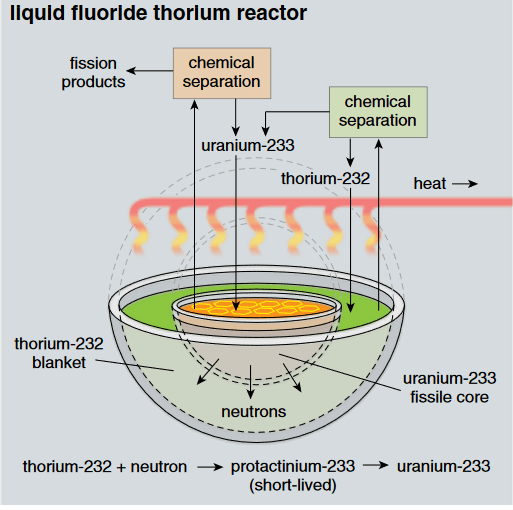
LFTRs are a type of 4th generation nuclear reactor design that using a liquid fluoride salt as the coolant and neutron absorbent. The advantages of using these fluoride salts include our vast existing knowledge of the material as they are commonly used in industrial processes such as aluminum processing and their thermal properties make them quite safe for use in a reactor. The fluoride salts that have been proposed for use in LFTRs have a boiling point of around 1400 degrees Celsius, to put that in perspective most magma has a temperature of between 700 and 1300 degrees Celsius so not even exposure to magma would cause a pressure explosion like Chernobyl. Additionally the reactors have a negative temperature coefficient of reactivity. If the temperature in the reactor rises beyond the intended range, the fuel itself responds with thermal expansion, reducing the effective are of neutron absorption, thus suppressing the rate of fission and causing the temperature to fall back into acceptable ranges. Because of this, with the appropriate formulations and configurations of nuclear fuel, runaway reactions become implausible.
100 Word Challenge (part 3)
In 2017 levels of Carbon Dioxide equivalent(CO2e) emissions globally total 45,261.2516 Megatons(Mt). Out of this total, China produced 27.51%, the United States produced 14.75%, and the European Union(EU28) produced 9.33%. These three economic blocks represent 51.59% of the world’s total emissions, while having only 29.68% of the world’s population. The US in particular gets 62.7% of its power from fossil fuel sources. A 50% transfer to nuclear power from fossil fuels would result in a 7.375% reduction in global emissions.
Nuclear Power and a Cleaner Future
Current, cutting edge nuclear power plant designs have the possibility to greatly reduce our dependence on fossil fuels and alleviate the unreliable consistency of other low emissions sources such as solar and wind. Older nuclear reactor designs are very inefficient both in terms of fuel usage and waste products that need long term storage while multiple new generation reactors show promise to utilize more of the fuel put in, being able to consume the waste from these older designs, and producing waste that is hazardous for much less time therefore requiring safe storage on a greatly reduced timescale. The world’s time to think about reducing it’s usage of fossil fuels is up and the time to act is now, waiting any longer will have catastrophic results for every future generation.
State of Hawaii’s Aloha+ Goals
The Aloha+ Challenge Dashboard is a website setup to track the progress of the state towards various renewable resource and sustainability goals. Some of these goals include moving away from fossil fuel energy sources and towards low to no emission sources, increasing local food production and decreasing reliance on imported food, diversifying the local economy and making the islands less dependent on tourism for revenue, and maintain and restoring marine habitats.
Page 2 100 Word Challenge
For most of my time in the military, my actions in the field were critical to getting the ammunition and explosives that my unit needed for training to them on time and safely. One time we had a training operation out in the desert close to Yuma, AZ but due to a lack of space at the main camp and in accordance with proper storage protocol, we had to store our ammunition in the middle of the desert far away from any range and base camp. I was given a team of about 15 marines to help guard the ammunition.
Community That Shaped Me
Without a doubt the community that has had the most profound impact on my values and actions would be my family. From the strict rules that forced me to develop my ability to lie and my love for school, to the experiments in the kitchen that gave me the ideas to mess with recipes and even come up with some of my own. Almost all of my thoughts and preferences have some sort of connection to how my family operated such as my fierce dislike of most large social situations and my independent attitude towards life.

